
How Will They Know Unless Someone Tells Them?

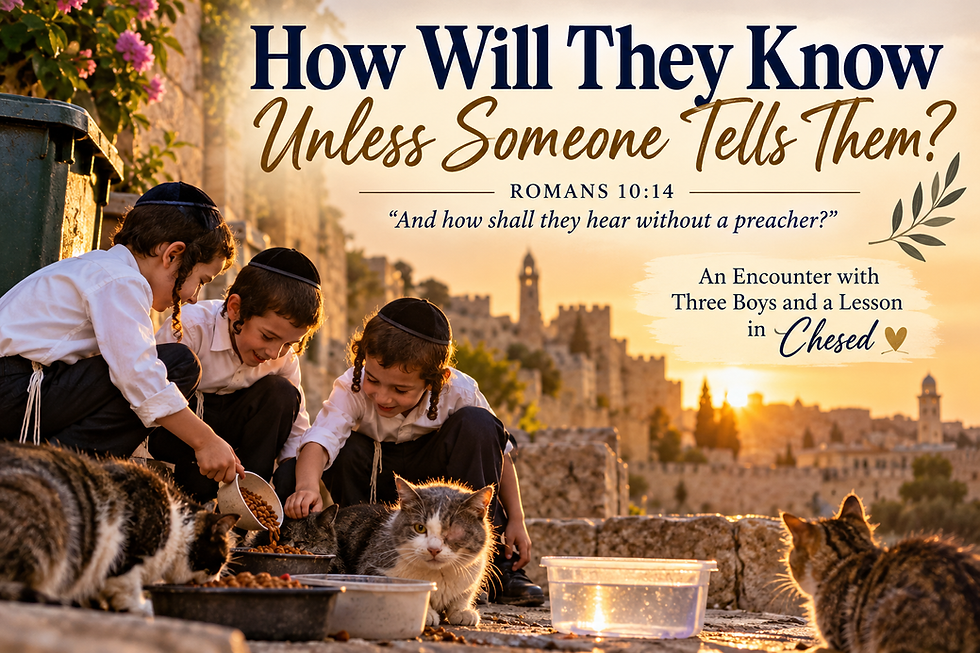
An Encounter with Three Boys and a Lesson in Chesed
“And how shall they hear without a preacher?” — Romans 10:14
Sometimes God gives us an unexpected opportunity to make a difference in someone's life, right in the middle of our ordinary daily activities.
Today, as I was walking down my street to feed the stray cats near the garbage bins, I noticed three young religious Jewish boys running around with a large stick, apparently searching for something.
My heart sank. I suspected they were looking for cats to chase, frighten, or perhaps even hurt.
I couldn't just walk by.
So I stopped and began speaking to them in my rather broken Hebrew. I explained that God created the world and entrusted us with the responsibility of caring for His creatures, not hurting them.
At first, they laughed. But I kept talking, and gradually something changed. They began to listen.
They followed me to the garbage bins, where I put out fresh water and food for the hungry cats.
“Why are you feeding them?” they asked.
“Because they're hungry and thirsty,” I replied. “They have no water because people come and throw it away.”
“Oh, they'll manage,” one boy said dismissively.
I looked at him and asked, “Would YOU manage without food or water?”
He became quiet. I could see him thinking.
A few minutes later, a cat appeared with only one eye.
“What happened to that cat?” they asked.
I explained that these cats have no homes, no families to care for them, and often no one to help them when they're sick or injured. I also told them that sometimes cruel boys hurt these helpless animals.
Then one of them asked again, “But why do you feed them?”
“Because it's chesed,” I answered. “Mercy. Lovingkindness.”
One of the boys immediately responded, “Yes, it's a mitzvah!”
“Yes!” I smiled. “It's a mitzvah to show kindness to animals!”
And then something wonderful happened.
Suddenly, all three boys wanted to feed the cats!
I gave each of them a scoop of food, and they eagerly took turns feeding the very animals they had apparently been chasing only moments earlier.
It was such a sweet sight.
The stick was put down, and eventually they walked away. I don't know whether this brief encounter will change their behaviour permanently, but I pray that a little seed of mercy was planted in their young hearts today.
And as I watched them leave, I thought about the words of the apostle Paul:
“How then shall they call on Him in whom they have not believed? And how shall they believe in Him of whom they have not heard? And how shall they hear without a preacher?” — Romans 10:14
How Will They Know?
How will people know what is right unless someone teaches them?
How will they understand mercy unless someone shows them mercy?
How will they learn to love what God loves unless someone takes the time to reveal His heart?
Of course, these boys were not necessarily ignorant of God's commandments. They were religious Jewish boys who even understood the meaning of a mitzvah. But knowing about God's commandments and allowing them to transform our behaviour are not always the same thing.
And isn't that true of all of us?
The Scriptures remind us that we, too, were once walking in darkness, disobedient to God and following our own selfish desires.
“For we ourselves were also once foolish, disobedient, deceived, serving various lusts and pleasures... But when the kindness and the love of God our Savior toward man appeared, not by works of righteousness which we have done, but according to His mercy He saved us.” — Titus 3:3–5
Before we came to know the mercy of God through Yeshua the Messiah, we too were estranged from Him. Romans 5:10 even describes us as having once been His enemies.
Yet God did not leave us in that condition.
In His great chesed (חֶסֶד), His covenant love, mercy, and lovingkindness, He reached out to us.
He did not simply condemn us for our wrongdoing. He made a way for us to be reconciled to Him.
And now that we have received His mercy, we have the privilege and responsibility of extending that same mercy to others.
Turning Hearts Back to God
The Hebrew word teshuvah (תְּשׁוּבָה) means repentance or returning. It comes from the Hebrew root shuv (שׁוּב), meaning to turn back or return.
When we see someone walking in ways that are contrary to God's heart, our first response may be anger, frustration, or condemnation.
But what if, instead, we took the time to explain, to teach, and to demonstrate a better way?
Proverbs 12:10 tells us:
“A righteous man regards the life of his animal, but the tender mercies of the wicked are cruel.”
Kindness to animals is not some insignificant matter. It reflects the character of our Creator, who cares for all that He has made.
Perhaps those three boys had never really considered what it feels like to be a hungry, thirsty, frightened animal with no home and no one to care for it.
But today, for a few moments, they were invited to see the world through the eyes of compassion.
And rather than simply being told what not to do, they were given an opportunity to do something good.
I wonder how many people around us are waiting for someone to show them the way back to God.
Not through harsh condemnation, but through truth spoken in love.
Not merely through religious instruction, but through a living demonstration of His goodness.
As Paul reminds us:
“The goodness of God leads you to repentance.” — Romans 2:4
A Little Seed of Mercy
I don't know what will become of those three boys. Perhaps tomorrow they will forget everything I said. Or perhaps the next time they see a hungry street cat, they will remember the woman who stopped them and explained the meaning of chesed.
Perhaps instead of picking up a stick, they will offer a little food or water.
Only God knows.
But I came home today deeply thankful that He gave me this small opportunity to speak into their lives.
Sometimes we think that sharing God's truth requires a pulpit, a microphone, or a large audience.
But sometimes our ministry is simply standing beside a garbage bin, speaking imperfect Hebrew to three young boys, and showing them what mercy looks like.
Never underestimate what God can do through one small act of lovingkindness.
After all, how will they know unless someone tells them?
And how will they understand chesed unless someone shows them?
A Closing Prayer
Avinu Malkeinu, our Father and our King,
Thank You for Your great chesed, Your mercy and lovingkindness, which reached us even when we were far from You.
Forgive us for the times we have been quick to judge others rather than taking the time to help them understand Your ways.
Give us eyes to see those who need Your love, courage to speak the truth, and hearts filled with compassion.
May the seeds of kindness we plant today grow into lives transformed by Your goodness.
And may we always remember that we ourselves have been saved, not by our own righteousness, but by Your abundant mercy through Yeshua our Messiah.
B'shem Yeshua HaMashiach — in the name of Yeshua the Messiah. Amen.
“He has shown you, O man, what is good; and what does the LORD require of you but to do justly, to love mercy (chesed), and to walk humbly with your God?” — Micah 6:8
Written by Hannah Nesher
October 17th 2026
Israel


Comments